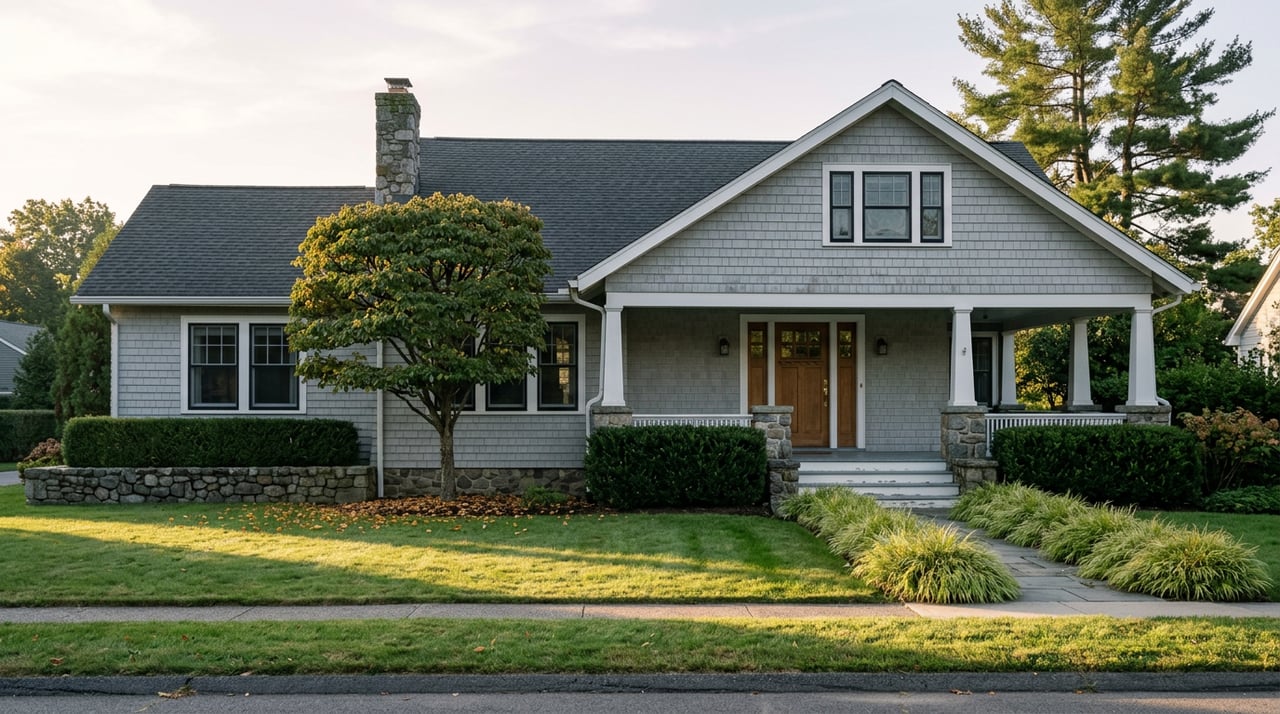
In West Roxbury, the house you want and the condo you might settle for are not competing in the same market at all. They move at different speeds, sell under different pressure, and respond to different rules. If you're comparing this neighborhood to others on the strength of a single median price, you're looking at a blended figure that obscures two different markets.
The Number That's Really Two Numbers
Pull West Roxbury's blended median and you'll see something in the $770,000 to $850,000 range depending on the month and the source, a figure that includes everything from a two-bedroom condo conversion to a colonial on a quarter-acre lot. That blended number is the one that shows up on portal search pages, and it tells you almost nothing about what it actually takes to buy here.
Split the data by property type and the picture changes. As of a February 2026 Realtor.com snapshot, West Roxbury single-family homes carried a median price of $764,750, sold at a 100 percent sale-to-list ratio, and moved in a median of 22 days. That points to a market with little room to negotiate, where the average sale is at asking.
Condos told a different story. Massachusetts Association of Realtors data for West Roxbury condos, covering the 2025 year to date through December, showed a median sale price of $599,000, cumulative days on market of 42, a sale-to-list ratio of 98.8 percent, and just 9 units of active inventory, translating to 1.7 months of supply. Slower, slightly softer on price, and with enough breathing room that a buyer can occasionally ask for something and get it.
Neither number is wrong. They're just describing two different competitions. One has almost no slack in it. The other has a little.
Why the Slack Only Shows Up on One Side
The gap isn't random and it isn't really about buyer taste. It's written into the neighborhood's zoning.
West Roxbury falls under Article 56 of Boston's zoning code, which was built specifically to protect the neighborhood's low-density character. In the 1F subdistricts that cover much of the neighborhood, the code caps a single structure at one dwelling unit. In the 2F subdistricts, the cap is two. There's no path to quietly adding a triple-decker or converting a single-family lot into a small condo building the way you might in a neighborhood zoned for higher density. You can read the full zoning text through Boston's Planning Department if you want the exact language, but the effect is simple: the single-family supply in this neighborhood is close to fixed. New houses don't get created by converting existing stock into more houses. They get created by building on land that wasn't built on before, and West Roxbury doesn't have much of that left.
Condos have a bit more flexibility, mostly through smaller-scale conversions and infill along corridors like Washington Street, which is part of why that segment carries more inventory and more days on market even in the same tight citywide environment. It's still a competitive market. It's just not a frozen one.
The city has started acknowledging the supply problem directly. Boston's Planning Department reported that as of September 2025, the city had permitted 51 accessory dwelling units citywide in 2025, compared with 34 for all of 2024, and it began meeting with West Roxbury residents as part of a Neighborhood Housing initiative aimed at loosening some of these restrictions, with a first draft of new zoning districts that the city had targeted for early 2026. That's real movement, but it's incremental by design. It's not going to turn West Roxbury into a neighborhood where single-family lots get subdivided at scale. It's going to add a basement apartment here and a garage conversion there.
The Subdivision That Made the News Because It Never Happens
If you want to see how rare new single-family supply actually is here, look at what counted as news in West Roxbury real estate this year.
In March 2026, the Boston Globe covered a newly listed house at 16 Starling Street, priced at $1.65 million for 2,700 square feet, and the detail the Globe led with wasn't the price or the finishes. It was the fact that the house sits inside The Preserve at Cardinal Hill, an entirely new subdivision of single-family homes built from scratch. The Globe called it flatly what it is: a Boston rarity.
That's the tell. A brand-new subdivision of detached houses inside Boston city limits is unusual enough to be the story, not a footnote in the story. In most growing suburbs, a new subdivision is routine inventory. In West Roxbury, it's the exception that proves how locked the existing supply really is. Every other single-family home on the market is competing for buyers against a backdrop where almost nothing new gets added, which adds to the pressure buyers face in this segment.
What This Actually Means If You're Choosing Between a House and a Condo Here
If your search is genuinely open between a single-family home and a condo in West Roxbury, the segmented data should change how you plan, not just what you expect to pay.
Going after a house means treating this like the least forgiving segment of the local market. The asking price should be your working assumption, rather than assuming you can negotiate below it. Financing needs to be airtight before you tour, because the timeline from listing to accepted offer is often measured in days, not weeks. Waiving a contingency you're not actually comfortable waiving, the exact trap DeMilia described, is a live risk here in a way it isn't in a slower market.
Going after a condo buys you something real: a little more inventory to choose from, a little more time to think, and occasionally a seller who will negotiate on price or terms rather than simply taking the best of five offers. It's not a consolation prize. It's a genuinely different negotiating position, and the data backs that up rather than just the anecdote.
If you're relocating from a market where "median price" means one coherent thing, the adjustment worth making in West Roxbury is to stop asking what the neighborhood costs and start asking what your specific property type costs, because the answer to those two questions can differ by tens of thousands of dollars and weeks of timeline.
A Few Questions Worth Asking Before You Write an Offer
Does the single-family squeeze ever ease up seasonally? Inventory in West Roxbury tends to loosen slightly from late summer into early winter, which is when more sellers list and buyer competition thins out a little. It doesn't erase the gap between segments, but it's a better window to negotiate than the spring rush.
Will the city's zoning changes affect prices soon? Not quickly. The city targeted early 2026 for a first draft of new zoning districts touching West Roxbury, and even once that draft moves forward, any resulting changes will phase in gradually rather than opening up supply overnight. If you're buying in the next year, plan around today's supply constraints, not a future that hasn't taken effect yet.
Is a condo really a fair substitute for a house here? It depends entirely on what you need day to day. A condo buys you flexibility in the transaction. It doesn't buy you a yard, a driveway, or the layout of a detached home. Buyers who treat the condo route as a financial decision rather than a lifestyle downgrade tend to be happier with the outcome than those who see it only as a fallback.
If you're weighing a house against a condo in West Roxbury, or trying to figure out which segment actually fits your timeline and your risk tolerance, John Maxfield has spent three decades reading Boston's neighborhood-level markets from both sides of the closing table. Get in Touch to talk through what the current split actually means for your search.
This article is general information, not legal, tax or financial advice. Consult a qualified professional about your situation.